
Notes on Scott Galloway’s "Notes on Being a Man"
New book offers candid advice for young men on work, relationships and life

I don’t often buy books on a whim. I wait for a title to generate buzz and trusted recommendations. Sometimes I’ll rely on the passing of years, decades or even centuries to see if a book meets the test of time before adding it to my “Want to Read” list. The recent title, Notes on Being a Man by Scott Galloway, is an exception.
When the book was released in November, I started seeing clips of the author on social media saying sensible things about the current worrying state of young men and how we should respond. As a father of two sons and three grandsons, and being a man myself, I have a keen interest in the subject. So I bought the book and read it, and I’m glad I did.
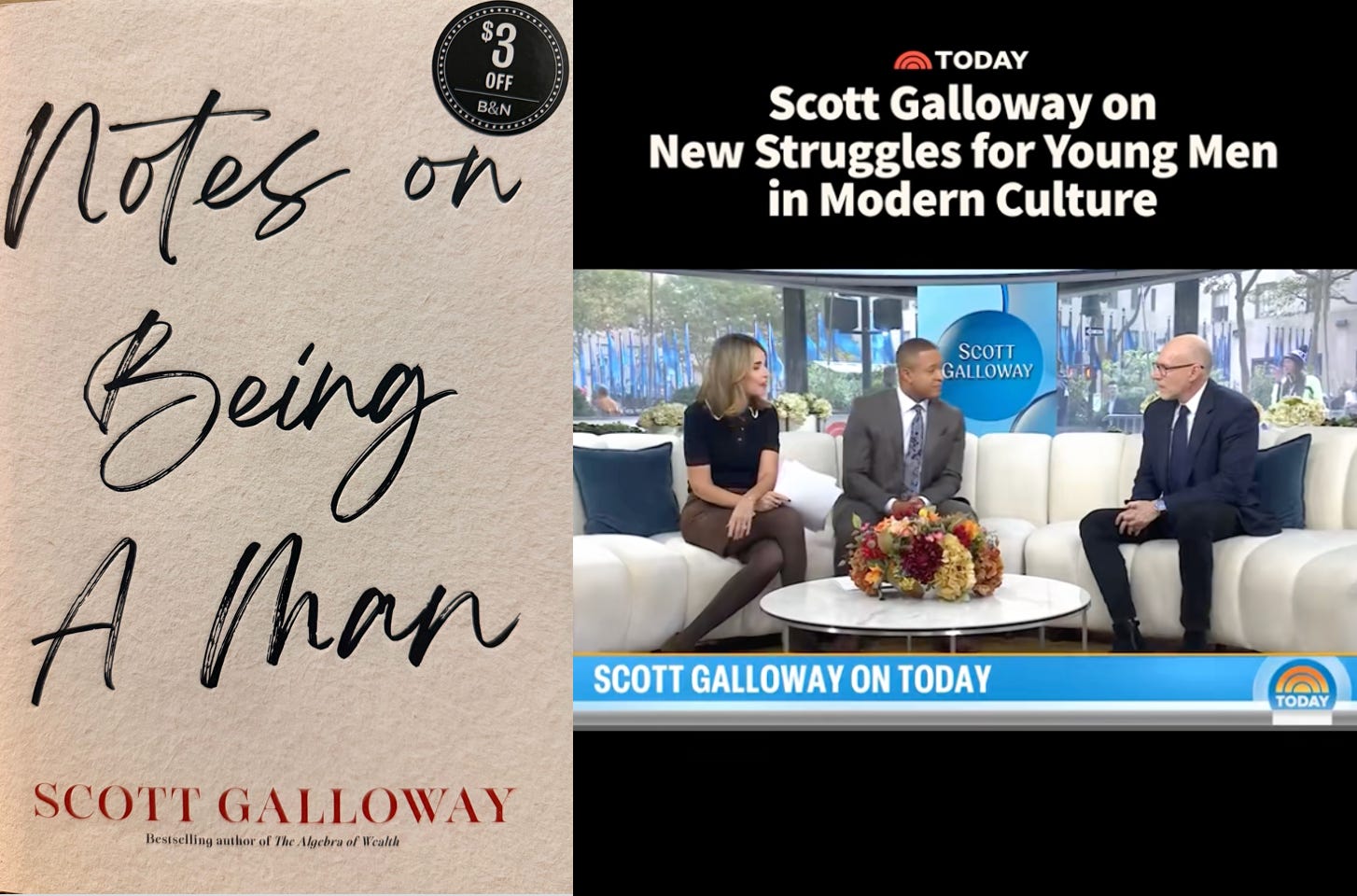
While I have a few quibbles (which I’ll save for later), there’s much to praise in this honest and candid book. Galloway draws on his own life experiences and accumulated wisdom, as well as a sprinkling of social science research, to speak truth to young men today and the people who (like me) care about them.
Galloway doesn’t approach the topic as a social conservative. He’s a self-confessed atheist who doesn’t appeal to traditional morality to make his case. He has no objection in principle to profanity, online porn, or pre-marital sex. Along with being a father of two teen-age boys, he’s a business professor at NYU, an independently wealthy entrepreneur, and author of a number of books that I haven’t read, such as The Algebra of Wealth.
Early in the book, Galloway dismisses the notion that being a male is a social construct assigned at birth. Manhood is a physical reality driven by genes and testosterone. We should embrace this biological fact, not deny it. “Physicality should begin early,” the author writes. “Boys are like dogs--they need to run and get exhausted, roughhouse, wrestle, build and smash things, sweat, whale against other bodies and objects. On the other end, dads should kiss their sons, hold their hands, hug them good night--model what fully functioning men have it within us to do and be, the affection and care humans share with those they love.” (p. 117)
Galloway recognizes that young men are at risk in our society. The Internet beckons them to think they can live fulfilling lives almost entirely inside and online. His advice to men starting their adult lives is to get out of the house and focus their energy on the real as opposed to the virtual world. “Whether shopping, gaming, swiping, posting, eating, looking at porn, streaming, gambling, or watching ESPN, take as much of this energy and time for the next couple years and reallocate that human capital to three areas: work, relationships, and fitness. This focus will pay dividends,” he writes. (pp. 92-93)
On work, Galloway shows a keen understanding of the value of dealing face to face with customers and colleagues. This is true of any kind of work, whether in an office or bagging groceries as a teen-ager—something the author did himself. Even if the pay and status are low, kids learn essential life lessons from their first foray into the workforce:
[F]or young people, an early job is as much about socialization as it is about cash. You learn how to work on a team, how to deal with coworkers and managers and customers, who can be jerks. You learn how to persuade and how to get people to buy something from you and how to survive in a capitalist economy. In sum, you start to learn that if you want success, you have to work for it--and that often means being willing to sacrifice for it. Few things build a young person’s self-respect, sense of purpose, and willingness to buy into society more than their first paycheck. Finally, working these jobs hardened me to rejection and hearing “No.” I learned to be scrappy and resilient. (p. 77)
On relationships, he urges young men to embrace the risk that comes from meeting people. That starts with getting out of the basement. “The amount of time you spend at home is inversely correlated to your success, professionally and romantically. Get out there not just to meet your colleagues, but also to chat up women, to expand your friend and network groups by interacting with people with different interests, goals, and hobbies, and to develop and refine your own visibility.” (p. 98)
On fitness, the book makes the common-sense case that boys and men are built for activity. He offers the simple test that you should try to raise the ratio of time sweating yourself compared to the time you spend watching other people sweat. Get out of the house. Move around. Eat healthier food. We would all be better off following that advice.
Raised by a single mother, Galloway has insightful things to say about marriage and the home. As he summarizes in one of his notes: “Being a good dad means being good to the mother of your children.” (p. 20) He’s clear-eyed about the impact of divorce on children. “[K]ids are almost never ‘resilient,’” he notes, remembering how it felt when he was 10 to be a liability in the eyes of the men who came to the door to date his single mother. In fact, “Most boys come apart when a male role model leaves. If there is no father present, the son is more likely to be incarcerated than graduate from college.” (p. 25) He cites research showing that kids of divorced parents are
on average unhappier, more anxious, and more likely to be depressed. They’re also less likely to graduate from high school and college, typically make less money, and are more likely to ultimately get divorced themselves. But: the same is true of children whose parents stayed in a high-conflict marriage. Relationships that breed severe conflict can be as hard on children as breakups. Chaos is the culprit, not legal status. (pp. 199-200)
Galloway refuses to let divorced dads off the hook: “There’s an assumption among divorced men that their scarcity creates ‘quality time’ whenever they see their kids. That’s bullshit. Quality time is a concept made up by a bunch of frazzled men who weren’t spending enough time with their kids and decided ‘quality time’ compensated for their invisibility. It doesn’t.” (p. 230) While I could do without the profanity, I appreciate the candor.
In his practical, secular way, Galloway endorses marriage and monogamy. He cites social science data that married couples in their 50s have three times the assets of their single peers. They live longer, on average, and express more happiness with life than single people. Their kids are far less likely to live in poverty compared to kids in single-parent homes. The key, the author concludes: “Taking the whole ‘till death do us part’ thing seriously, … From an evolutionary perspective, monogamous relationships improve survival odds for offspring, benefiting our species overall.” (p 184) He warns married men to beware pornography, which he rightly notes leads to the objectification of women. “A key to a successful marriage is reserving and allocating your sexual energy for and toward your wife.” (p. 195)
Galloway has lots of other useful observations that will benefit anyone who reads the book. He notes that mundane daily habits can lead to big gains. “Small, deliberate, regular efforts accumulate and in time pay off. In other words, the most powerful force in the universe …. is compound interest.’”(p. 35) A related message is that it’s OK if you aren’t sure where your current path is taking you. “Note: Almost no one has a career map. Put one foot in front of the other and see where it takes you.” (p. 92) He reminds young men to mind their “man-ners.” Treat women with respect. Open doors for them. Pay for dinner on a date. And don’t fear failure. Even professional athletes miss the mark most of the time. It’s OK, even good for men to express emotion. Share your feelings. Initiate conversations, with women as well as other men: “Most boys and men are hungry for connection and deeper conversation. My advice: take a risk, go first, see what happens.” (p. 166)
This is all good to great stuff. I hope millions of young men get exposed to these challenging thoughts and embrace a richer, fuller life marked by self-discipline, thoughtful behavior, and connections to other human beings.
On the negative side, Galloway’s regular use of profanity detracts from the appeal of his message. One AI inquiry told me the author uses the F word 50 to 60 times in the book—it seemed even more often to my sensitive ears. I suppose this gains him credibility with a certain young audience, but it will put off other potential readers who could benefit from his message. Minding your language around strangers strikes me as good manners.
Galloway also throws out a few observations about society and public policy that sound half-baked. For example, he complains about commercial air travel, describing flying economy these days as “a clusterf***.” The author complains that, “Asking anyone to sit upright for half a day in a pressurized tube is unhealthy, abusive, and gross.” (p. 229) This sounds to me like a wealthy person trying to explain why he always flies business or first class, even sometimes by private jet. In fact, as my wife and I’ve experienced lately, the logistics of economy air travel actually seem to be getting better—fewer delays, faster security checks. As a 6’2” man, I don’t get any intrinsic pleasure from sitting in an economy seat for a 7-hour flight to London, but c’mon! I’m crossing a continent or an ocean in a few hours in what travelers just a century or two ago would consider real comfort. (If you haven’t seen it yet, I beg you to watch this 4-minute spiel by comedian Louis C.K. on the Conan O’Brien show from 2009. It’s become famous as the “Everything is amazing and nobody is happy” rant and it goes right to my point. And yes, flawed people can still speak useful truths.)
More broadly, Galloway affirms the popular view that life is uniquely difficult for young people these days. Americans certainly do face economic challenges in 2026, but can we really say that young adults today are “up against economic realities that their parents and grandparents simply were not: rising inflation, housing prices, unbridled student debt”? I don’t want to minimize the challenges Millennials and Gen Zers face today, but let’s keep some perspective. When I graduated from college in 1979, inflation and mortgage rates were hitting double digits, we needed to get in line to buy gas, and our leaders were talking about national “malaise.” My parents entered adult life during the Great Depression and World War II. Every generation faces its own challenges; I’m not sure the younger folks today deserve a special pity party.
The author also seems to fall into some inconsistencies. He rightly praises the benefits of entry level jobs for young men, yet a few pages later he casually endorses a $25 minimum wage. I would think an economics major and business professor would be mindful of the damage such a high minimum wage would do to entry-level job creation. He also has harsh things to say about social media platforms, while a few pages later he mentions a TikTok video his sons were watching.
Those last few observations may sound like the petty complaints of a retired policy wonk, and maybe they are. They certainly shouldn’t distract anyone from the fundamentally important points the author makes about what it means to be a mature and fully function man in America today.
A friend gifted me this book back in December, and I was about halfway through it when you visited. He gave it with the intention that we as fathers should be aware of the challenges our young men face as they grow up in the modern world, but also generally thinking about how to be better men & fathers. I was pleased to see your writeup!
Inspired by Prof G, I now do a 10 minute workout with Davis every night we are together. We put on imagine dragons and I set the timer. He picks a workout, and we do it for a minute, then 15 second rest while I pick the next 60 second workout, then he picks, and so on. It took a bit to get into the groove, but now it is just something that we do, and we have a lot of fun with it.
Regarding the profanity, I have heard him talk about this on his podcast. He is intentionally provocative in what he says, and he will drop F-bombs to emphasize a point. Its part of his style. It may just be me, but it seems that the use of certain profane words has become more common. It could just be the industry that I am in though. It doesn't bother me, but I could see it being distracting.
In his writing, Scott speaks vulnerably about his failures, his relationships with his father, mother, and others, and investigates why he is the way he is - such as his relationship with money, attention, women, etc. The notes are valuable, but I think the context with him opening up about his failures in that way would make this resonate more for a young man reading this book.
Overall I enjoyed it. A lot of good stuff in here. I would have gotten even more value from this had I read it in my 20s.
- Alex
PS - I have finished "Shot Ready". Loved it! I'll share notes on that separately. I have made it about 1/4 way through Stuck, and not sure I am going to finish that one. Will share some thoughts there.
Yes—boys need to MOVE and test their physical strength. Testosterone must be harnessed and channeled in healthy ways, not suppressed. This author makes many good points. Thanks for the review.